Radio9 · News in English
Alessia Luongo: the electric insomnia of METAFICTION
A light bulb left on, the voice and object theatre: Italian artist Alessia Luongo talks about METAFICTION and the single 60 Watts of Insomnia, announced for 13 November.
10 November 2026 · Leggi in italiano
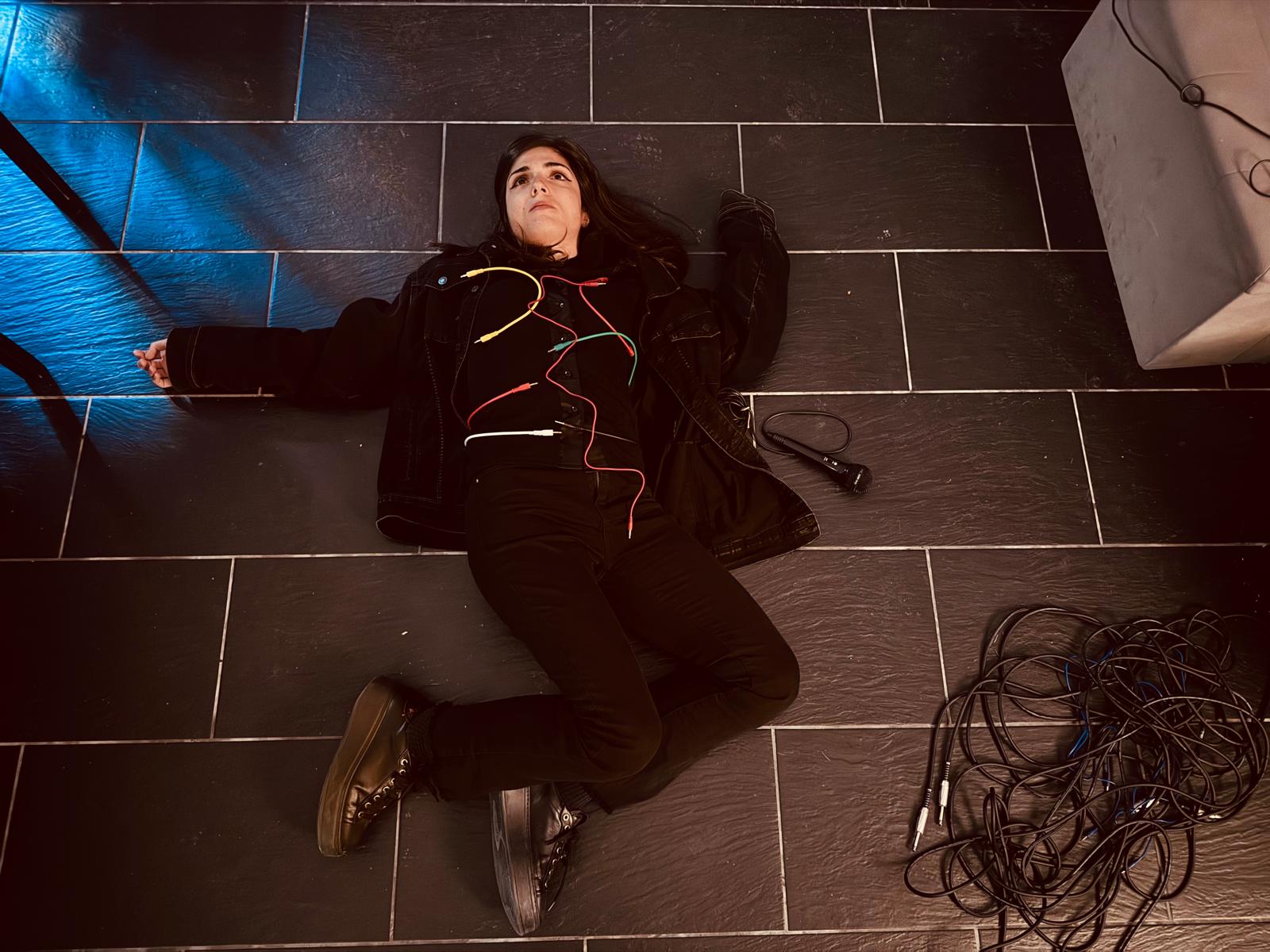
A light bulb left on, an electric guitar that loses its shape, a voice working on breath and consonants. Alessia Luongo talks about METAFICTION, a five-track EP due in December 2026, preceded on 13 November by the single 60 Watts of Insomnia. Between electronics, improvisation and object theatre, the common thread is the physical behaviour of sound.
Written interview by Nicola for Radio9, translated from Italian. Questions and answers shortened for length and clarity. Version approved by the artist.
1. What image does 60 Watts of Insomnia start from? How did you turn it into sound?
The starting point of 60 Watts of Insomnia is an extremely simple image: a light bulb that stays on in a bedroom because of a current leak. I was interested in the contradiction between an apparently harmless object, part of our everyday life, and the possibility that its presence becomes unbearable.
To build this tension I started from electric guitar and analogue synthesizer, working on feedback, interference and the sonic possibilities generated by cables and connections. I processed these materials to evoke the behaviour of a short circuit: sudden discharges, irregular pulses, friction and interruptions suggesting an unstable electrical system.
I worked on the recordings through distortion, layering, time manipulation and resampling. I didn’t want the sound to illustrate insomnia. I wanted it to behave like insomnia: to insist, break off, restart incongruously and never allow a real resolution.
2. In METAFICTION guitar and voice change identity. Can you give two concrete examples?
I’m interested in understanding how far a source can be transformed without completely erasing the physical traces of the gesture that produced it.
A concrete example is False Entrance, the track that opens the EP. I started from the electric guitar, using it mainly as a generator of sound mass, friction and harmonic concentrations. Instead of looking for recognisable melodies or sequences, I worked on clusters and sustained gestures, favouring the density of sound and its irregularities.
In The Other Mouth, for example, I chose to work exclusively with vocal material. Here I was inspired to explore the voice before its communicative function: breath, the friction of consonants, the length of vowels, pitches and discontinuities of the emission.
Transformation, for me, is not a technological exercise. It’s a way of challenging our perceptual habits. I’d like the listener to be constantly in the position of recognising something and, a moment later, no longer being sure of it.
3. From improvisation to composition: how do you choose which accidents to keep?
While improvising I mostly try to listen to how the materials react, what resistance they offer, what unexpected relationships form between a gesture and its sonic consequence. Technical errors, interference, unexpected saturation or small, apparently marginal phenomena can emerge. An accident, on its own, guarantees no artistic quality.
Composition really begins when I return to those materials and ask myself what function they could take on within a structure.
For me a rupture becomes necessary when it changes the meaning of what precedes it or transforms the way we hear what comes after. An acoustic shock is not enough. A fracture must have consequences.
I believe one of the risks of experimental music is confusing complexity with an accumulation of surprising events.
4. What carries over from Dyno on the Moon and Pugni di Pezza to a record with no visible stage?
In Dyno on the Moon, for example, I used ordinary clothes hangers to evoke the fragility of the lunar ecosystem. I was interested in the disproportion between the banality of the object and the complexity of the image it could suggest.
An object can suggest a rhythm through its movement, a structure through the repetition of a gesture, or a musical tension through its physical precariousness.
In Pugni di Pezza the movement of the puppets and the sound composition influence each other. Sound can provoke an action, anticipate it, contradict it or interrupt it. In the same way, a gesture can suggest a new musical direction.
When I work on a purely sonic project like METAFICTION, this dimension doesn’t disappear, but it changes form. Sound masses can collide, frequencies can create friction, an interruption can work like a sudden gesture. Even silence takes on a theatrical dimension, because it changes the listener’s expectations and the perception of what surrounds them.
5. What have audiences of children and adults taught you? Where do you suggest entering METAFICTION?
I think it’s important to distinguish the complexity of a work from the difficulty of building a relationship with it.
A child can approach a sound through movement, surprise, rhythm or a particular timbral quality, without necessarily feeling the need to give it a meaning straight away. An adult may look for references, structures and explanations, but can also surrender to an equally immediate listening.
I think a lot about the fact that accessibility doesn’t necessarily have to coincide with simplification.
I’d rather suggest paying attention to small changes. Sometimes a repetition isn’t really a repetition: a detail shifts, a frequency emerges, a voice seems to belong to another space, a pause retroactively changes what we have just heard.
I don’t think it’s essential to immediately understand what you are listening to. Sometimes the most interesting part of a sonic experience begins precisely when we are no longer sure what we have in front of us.